For: Darril Wilburn
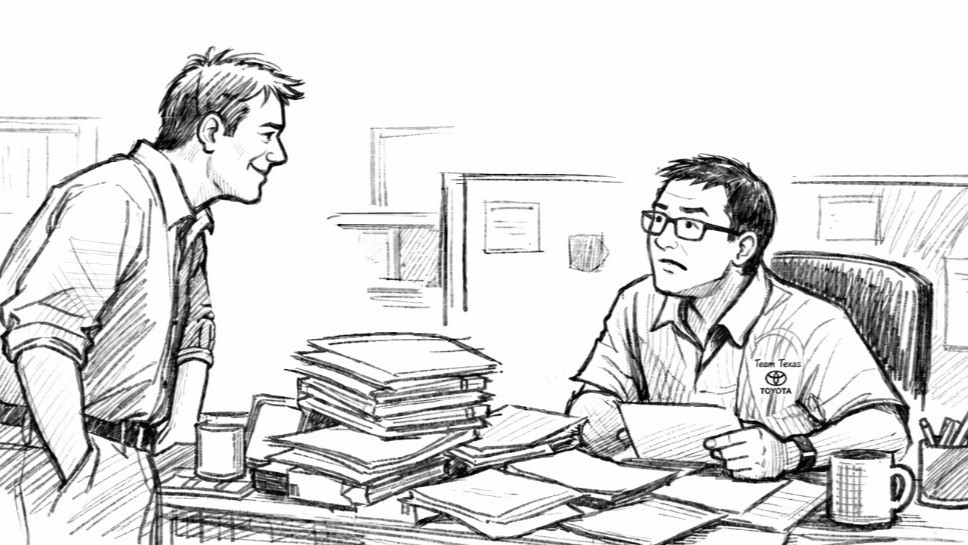
I was walking through the office area during the Toyota Texas startup when I passed a Japanese coordinator’s desk. Papers stacked, documents scattered, nothing in neat rows. I jokingly said: “That’s not good 5S.”
He looked up. “You think that because you don’t really understand the purpose of 5S.”
I’ve been sitting with that response for almost twenty years.
His desk looked disorganized to me. But everything on it was exactly where he needed it for his work. He had arranged his space around function, around the actual sequence of his work, and it was efficient. Appearances had nothing to do with it.
That exchange clarified something I had been getting wrong. 5S is about making work function well. Cleanliness can be a byproduct, and a welcome one. But cleanliness and 5S are different things, and when we treat them as interchangeable, we diminish 5S.
The language problem
Cleanliness and orderliness are good organizational values. A clean, well-kept workplace reflects discipline and respect, important things. The problem is when we call all of it 5S. When everything gets labeled 5S, the term stops carrying meaning. If we see someone sweeping and say “good 5S,” do we actually know it’s 5S? And if it is, which S?
The answer to that question reveals how far the language has drifted. When we say 5S, we usually mean cleanliness.
When Toyota says 5S, they mean the conditions required for work to flow.
The confusion has a history
Understanding why this confusion is so persistent requires a little history.
In Japan, what we now call 5S started as 3S: Sort, Set in Order, Shine. Those three were embedded in standardized work. Operators cleaned their stations, organized their tools, and removed what didn’t belong because that was part of how the work was defined. Announcing it or auditing it separately wasn’t necessary. It was the work.
Hiro Yoshiki, a former Toyota executive who spent decades applying and teaching the Toyota Way, makes an observation about this original framework, “The first two S’s are the critical ones. Sort removes what doesn’t belong. Set in Order organizes what remains so that anyone can see immediately whether conditions are normal. Those two create the condition that makes abnormalities visible. Everything else is downstream of whether those were done well and for the right reason.”
When Toyota began expanding outside Japan, the cultural assumptions behind 3S broke down. American workers didn’t share the same baseline, and the first three S’s couldn’t be taken for granted. So Standardize was added as an explicit instruction to do what Japanese workers were already doing as a matter of course: make the first three S’s part of the standard. Sustain followed the same logic one level up, when standardization alone wasn’t holding.
Each S added to the original three represents something that had to be made explicit because it could no longer be assumed. The further 5S gets from the work itself, the more external support it requires to survive.
The English translations made things worse. “Shine” suggested making things sparkle rather than cleaning as a form of inspection. “Standardize” implied writing general process standards rather than standardizing the organization routines that keep the first three S’s intact. “Sustain,” stripped of the cultural meaning shitsuke carries in Japanese, got reduced to audit compliance.
Where 5S has purpose
The closer we get to core value-added work, the more essential 5S becomes.
This is especially true in well-designed cyclical work, where variability is the enemy.
When a process has standardized work with clear steps, sequences, and timing, a pull system pacing work to customer demand, and clear connections to upstream and downstream processes, 5S is non-negotiable. If the items and information I need are not where they should be at the moment I need them, I will not complete my work cycle within takt time.
In that environment, every work cycle is an automatic 5S audit. If something is out of place, the cycle exposes the abnormality immediately. No one needs to walk through with a clipboard. The work does the auditing. An audit-driven approach almost always deteriorates over time. The work-driven approach sustains itself.
Concentric zones
I think of 5S as operating in concentric zones around the core work.
In the innermost zone, the zone of standardized work, 5S is self-enforcing, self-auditing. Any deviation introduces variability, the enemy of standardization. Maintaining proper conditions here is natural because the work demands it. This is the easiest zone to sustain, precisely because the consequences of failure are immediate and visible.
In the next zone out, support areas including nearby storage, shared tools, and upstream or downstream workspaces, 5S is helpful but requires deliberate effort. The work cycle doesn’t enforce it automatically. Maintaining order takes discipline.
In the outermost zone, office and administrative areas, 5S compliance almost always depends on management audits. That is where it starts to fall apart, because the urgency isn’t there.

The client with no pull system
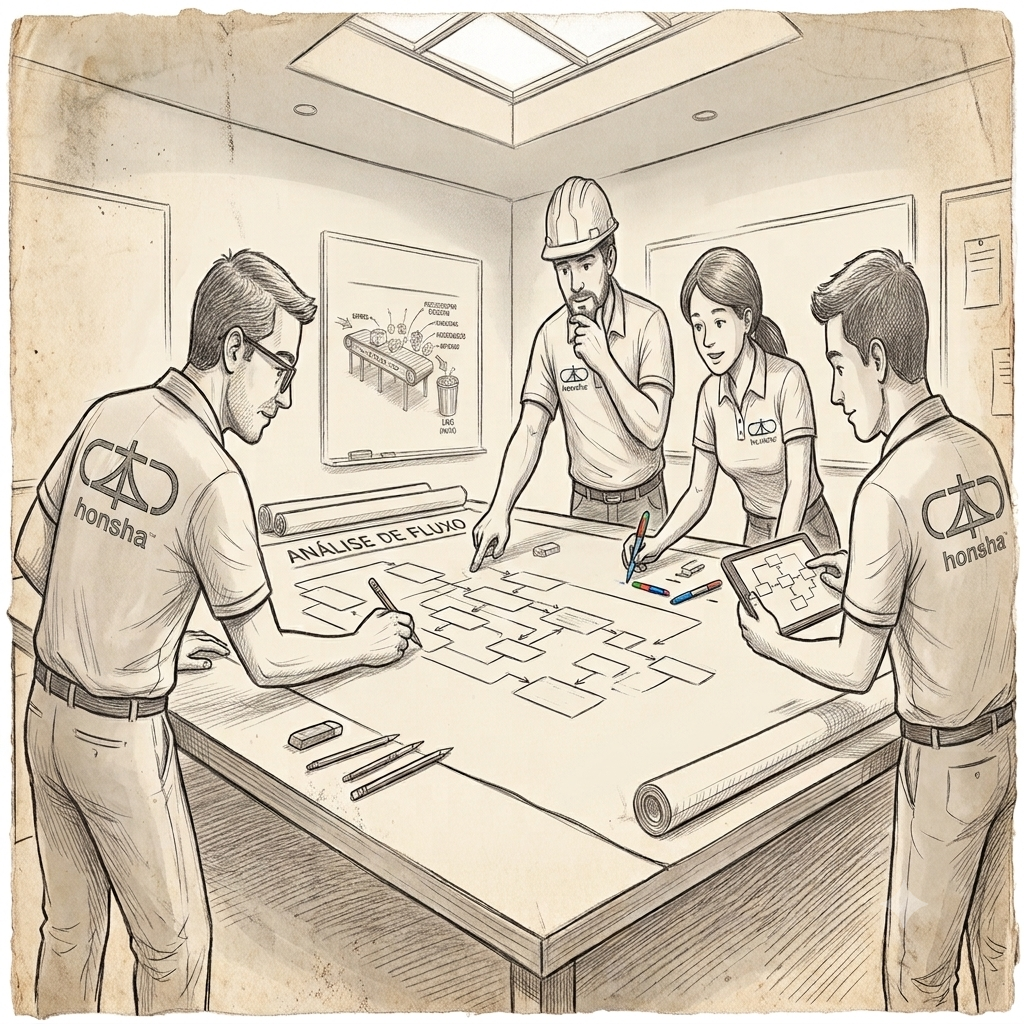
I saw this play out at a potential client. The VP of Lean walked me through their plant and was a bit embarrassed about the state of cleanliness. He showed me his 5S program: cleaning schedules, audits, checklists. They had tried everything, and discipline was still weak. He was visibly frustrated. A few days later, during a leadership workshop, we took a small group to the genba to observe an operator’s work and try a kaizen exercise.
The operator was enthusiastic about helping us and we worked with him to rearrange his process, streamline steps, and eliminate waste. About an hour in, I noticed his production had stopped and nobody seemed to care. No andon signals. No supervisor checking in. No one asking where the work was.
There was no pull system. The operator worked at his own pace, no takt time driving the work. In that environment, 5S has no teeth. If there is no structured work cycle, a misplaced tool has no consequence. Without demand, the only reason to maintain 5S is to satisfy an audit.
The taped monitors
The further from the core work, the more creative the interpretation.
A client CEO once asked me to conduct a 5S audit of their back-office area, I reluctantly agreed. Walking through with their audit sheet, I noticed employees had taped off the locations of their computer monitors on the desks. These were the old large CRT screens.
I asked one employee, “Would you notice if your monitor was missing, even without the tape?”
She laughed. “Of course. But the boss said we needed to be ‘5S-ed.’ And honestly, we did this yesterday because we knew you were coming.”
One purpose of 5S is to make abnormal conditions immediately visible. Nobody needed a visual cue to spot a missing 50-pound monitor. The tape was beside the point. The biggest beneficiary of that kind of implementation is the company that sells you the tape.

When I looked around, the office was genuinely tidy. My business partner Sammy Obara would have recognized it immediately: “The best place for waste to hide is in a clean, tidy, and organized place.” He doesn’t mean that cleanliness is bad. He means that cleanliness without the first two S’s done properly gives you the appearance of control without the reality of it.
Office 5S can make sense in the right context. In shared areas like a copy room, a standard location for common tools helps people find what they need quickly. An organization that values orderliness can absolutely use visual standards to reinforce it, and they should. Just be clear about what you are doing and why. When everything is 5S the term loses its meaning.
On audits and the 1-to-5 scale
If a formal audit system is necessary, the message we send in the design is important. Many organizations rate 5S compliance on a 1-to-5 scale. If we need a certain standard condition to complete work with high quality, low cost, and short lead time, then the condition is either met or it isn’t. Yes or no. In compliance or out of compliance.
When someone decides a condition scores a 3 and pushes it to a 4 or a 5 by making things cleaner and shinier than the standard requires, they are introducing processing waste into the audit itself. Effort that does nothing to improve the work. That runs directly counter to the purpose of 5S, which is to identify abnormality so we can reduce waste.

Inside out
5S works from the inside out. The core work zone is where it is essential, where the work itself enforces it, and where deviation has real consequences. Moving outward through the zones, the urgency decreases, the connection to the external customer loosens, and sustainability depends more on willpower and management attention, which fades.
The reason 5S so often gets reduced to housekeeping is that the additional S’s were designed to compensate for what Japanese culture had carried invisibly. Strip away that understanding and what remains can look like a cleaning program.
Darril Wilburn
Senior Partner at Honsha.ORG and co-author, with Hiroyoshi Yoshiki, of the forthcoming book Courage, Humility, Kaizen. Hiro is a former Toyota executive who was directly involved in creating The Toyota Way 2001. The book explores how cultural and language gaps shape the way Toyota’s system is understood and practiced outside Japan.
Additional Links
Visit the Honsha website:
https://honsha.org/?noredirect=true
Explore other articles about Lean and Toyota at Honsha:
https://honsha.org/blog/